Spamming has gotten creepier.
"Nobody Knows Anything," Part II
The quote in the title is from famed screenwriter William Goldman (The Princess Bride, Butch Cassidy and The Sundance Kid), commenting about the process of making movies. His point was that, no matter how scrupulously studio heads read scripts and make decisions, the reality is that everyone is pretty much guessing what movies are going to be huge successes and what ones are going to flop. I can rail against studios for ignoring artsy projects that get picked up by indie studios and turned into hits (a few years ago, all five Best Picture nominees had, at one time, been rejected by the same studio), but it's an impossible gig. No one really knows, for sure, what projects will be huge and what will tank. Having the Wachovski brothers, makers of the Matrix films direct a kid's film starring one of the best young actors out there, based off a very popular cartoon seems like a great idea to me, but Speed Racer was a disaster and bombed at the box office. So I can't point fingers.
The argument is, though, if the same holds true for an NBA draft. Is it really just all potluck? Were the Hawks misguided in choosing Shelden Williams over Brandon Roy? Or just unlucky? Can I really fault them for not picking Chris Paul? Or Tony Parker? Were Priest Lauderdale, and Royal Ivey bad selections - or just bad luck?
We can't know for certain, but a good test would be to see if the opposite is consistently true. If the Hawks are the worst drafting team in the NBA, what's the best drafting team? And has their organization consistently drafted well - or just occasionally gotten luck?
Well, here's the first argument that it's all luck: there aren't that many teams that draft that well in the NBA. A lot of the teams have made it through by filling their rosters through trades and free agency - with the occasional home run. Still, there are teams that have shown consistent foresight in the past ten years: Boston (Paul Pierce, Joe Johnson, Al Jefferson) has shown a real ability to spot top-tier talent in the middle of the first round, but they've also spent much of that time trying to amass mid-round picks, hoping to get lucky, and they've made a few mistakes along the way (Tony Allen over Kevin Martin, for example). Phoenix has also shown a propensity for making strong picks in the first round, whether early (Amar'e Stoudamire #4, Luol Deng #7, Shawn Marion #9) or late (Michael Finley #21, Steve Nash #16, Rajon Rondo #21). No one team, though, has drafted as consistently well in the middle of the first round as the Hornets, even late in the first round. 1996: Kobe Bryant (#13), 1998: Ricky Davis (#21), 1999: Baron Davis (#3), 2000: Jamaal Magloire (#19), 2003: David West (#16), 2004: J.R. Smith (#18), 2005: Chris Paul (#4). Wow.
Other teams have picked well despite never making the draft a priority. San Antonio has shown a propensity to trade their draft pick away at the slightest provocation, and because of their consistent winning ways, tend to pick at the very end of the first round anyway - something like 27th or 28th, usually. Even with this exceedingly large handicap, they've shown that they make every pick count - either finding All-Stars (1999: Manu Ginóbili at #57, 2001: Tony Parker at #29, ) or very solid role players (2002: John Salmons #26, Luis Scola #55, 2003: Leandro Barbosa #28, 2004: Beno Udrih #28). One of reasons the Spurs have remained a solid team, year after year, is that they continue to complement their stars with extremely well-selected draft picks.
Now we have both sides. The teams incapable of making good choices and the teams that never seem to go wrong. And everyone else is hit or miss. So, either:
a. It's all luck and some people get consistently lucky
b. It's not luck and some organizations are just impossibly terrible at it.
c. It's part luck, part skill, and the part that's skill is something the Hawks don't have any of.
I'm going for (c). But the major thing we've uncovered is this - if it's all luck, or mostly luck, then no team could have the sort of string that the Spurs, or the Hornets, or the Suns had - or the Hawks either, for that matter. It's just not possible.
So the people who excuse themselves for bad drafts as "there was no way we could know" are fooling themselves. Good drafting teams draft well - consistently. Bad drafting teams draft poorly - consistently. Luck absolutely plays a part in it, but there's a difference between Len Bias and Darko Miličić.
And unfortunately for the Hawks, there's a difference between Shelden Williams and Brandon Roy.
Even by my already low standards...
...I still vomit at the thought. A British chip company is releasing a new flavor of crisp that tastes like squirrel.
Alright, I'm a little curious to try a bag.
"Nobody Knows Anything" - A Study In Desperation in the NBA Draft
I was reading an article the other day where they offhandedly mentioned Andrea Bargnani, and said "it's all very disappointing for a number one pick." And I said "Bargnani was a number one pick?" That was only three years ago, but I'd already forgotten. That's how little impact he's made in his short career. Sad.
Weirder to me is that I'd so completely forgotten about Bargnani's draft position, a footnote in 2006 draft, one of five players selected before Brandon Roy. It seems we forget a lot about draft classes - we remember the strong classes (1999) and forget the weak ones (2000), we remember  the truly horrendous picks (Atlanta picking Marvin Williams over Chris Paul, even though Paul - for reasons that escape us even now - wanted to go to the Hawks). But how often do we look back and study the patterns in NBA drafts? Players get traded so quickly and so often in the NBA that we lose who drafted who where, but it's fun to study and see who's been consistently good and who's never really been able to grasp what drafting is all about.
To be fair, sometimes there are regime changes - it's unfair to rail against the current Knicks for the crimes of Isaiah Thomas - but there are always organizations that make a study in futility late every June, regardless of who's in charge. Jets fans know exactly what I'm talking about.
I went back through and studied each draft from 1998 to 2008 for patterns, looking for organizations who had foresight and recognized talent. I graded well for every player selected who became a consistent starter and/or All-Star, and negatively for every player selected in a draft position where a far superior player was selected one to four spots later. Four spots was my limit (I occasionally stretched it to five or six spots if more than one superior player was selected following the pick) because it's only fair to judge teams according to how a player is rated by everyone. It's fair to ridicule the Wizards for drafting colossal bust Kwame Brown with the first overall pick in the 2001 draft instead of Pau Gasol (#3), it's less fair to knock them for missing future All-Stars Tony Parker (#29) and Gilbert Arenas (#31). A lot of other teams missed their chance, too - what's noteworthy is when you have two similarly rated players and you consistently choose the wrong one.
I graded especially harshly on teams that drafted a quality player and dealt him on draft day for a crummy player two spots down and a second round pick. This, I feel takes a special sort of lack of foresight. Occasionally, though, these trades are a steal: Dallas drafted the well-nicknamed Robert "Tractor" Traylor, then traded him for future MVP Dirk Nowitzki and a first rounder later in the draft. Even though the later round pick was Pat Garrity, that's still nice work.
Some of the results surprised me. First of all, for a team as successful as they were from 2000-2004, Detroit did not draft well. There was the obvious misstep: Darko Miličić with the number two pick over Carmelo Anthony (#3), Chris Bosh (#4), and Dwayne Wade (#5) in 2003, Rodney White (#9, who's now playing for Zhejiang Guangsha in China) over Joe Johnson (#10 by Boston, who traded him to Phoenix for Tony Delk, humiliatingly. Curse you, Rick Pitino!) in 2001, and Mateen Cleaves (#14) over Hedo Turkoglu (#16) and Jamaal Magloire (#19) in 2000 (admittedly, that draft class was a complete mess). White and Cleaves are now all out of the league and Miličić averaged 7 points a game for a less-than-stalwart Memphis team last year. On the flip side, with the exception of Turkoglu, all of those players they missed out on are All-Stars or All-NBA players.
On the flip side, some of the results utterly failed to surprise. Tops on that list? The sad and flailing Minnesota Timberwolves are just as bad at drafting as I had guessed. It's too early to judge the 2008 draft, but you've got to figure they've already got to be regretting dealing O.J. Mayo for Kevin Love, right? That's not even their worst pick. They drafted sure-thing Brandon Roy (#6) and - I hate this - traded him for Randy Foye (#7) in a five player trade that just moved flotsam and jetsam around. Who in the world is that excited to get Sebastian Telfair? Even in the worst years of pathetic Celtic ignomy, I never got excited about Sebastian Telfair, especially if it would've meant I would lose Brandon Roy. And I got excited about everyone. Even Tony Delk. And let's not forget 2005's pick of Rashad McCants (#14 - 2008 stats: nine points, two rebounds and an assist per game) over Danny Granger (#17 - 2008 stats: 26 points, five boards, five dimes, and an almost certain All-Star slot). Yeesh.
Before I reveal the worst drafting team of the past ten years, let me just point out a particular draft that's worth remembering: in 2004, the Utah Jazz - never good drafters to begin with - had perhaps the worst draft in NBA history - or in the history of sports in general. They had three first round picks (#14, #16, and #21) and they made just truly outrageously bad picks every time. At #14, they picked Kris Humphries (averaged 3.5 points in two season) and #15 was Al Jefferson (2008 stats: 23 PPG, 11 RPG, 2 blocks). At #16, they picked Kirk Snyder (now playing in China for the Zhejiang Horses), which was immediately followed by Josh Smith (#17), J.R. Smith (#18), and Jameer Nelson (#20). At #21, they picked Pavel Podkolzin, and five picks later, Kevin Martin (24 PPG and rising) gets picked. To sum up, in the eight picks between #14 and #21:
a. four stars were selected
b. the Jazz had three of those picks
c. they got none of those stars, nor in fact any usable players. Ouch.
Still, they can take heart because: they are not the Atlanta Hawks. For a team with as young and talented a starting five as Atlanta has - Mike Bibby is 30, Joe Johnson 27, Josh Smith 23, and Al Horford and Marvin Williams are 22 - they've drafted remarkably poorly. Take a look:
In 2006, they drafted Shelden Williams over Brandon Roy. Williams (who has a career total of 4.8 points a game) is now basically only famous for this fact and the fact he's married to Candace 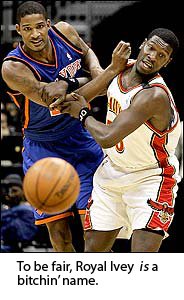 Parker. If you're overshadowed by a player from the worst-paying major sports franchise in America, you're in trouble. That's not even the worst of it, though, the worst was taking Williams over Paul: Williams is averaging 14 points, 6 rebounds and one and a half assists per game, whereas Paul is the best point guard in the NBA and in competition to finish up as one of the top five guards of all time.
Plus, there's a consistent pattern of just missing out on the good players. They barely missed on Chris Duhon (#38 and top-six in assists this year) in 2004 for Royal Ivey (#37 with 3.4 points per game in three seasons). It's unsurprising though, since the year before, with the exact same pick, they went with Travis Hansen (lasted half a season before flaming out) over Steve Blake (starting at point for the playoff-bound Blazers) one pick later.
Two years before that, they drafted Pau Gasol with the number three pick and traded him to Memphis for Shareef Abdur-Rahim (admittedly, even now this is a defensible choice). But that wasn't the only problem they had that night. They later drafted Jamaal Tinsley with the 27th pick (who ended up packaged in the Abdur-Rahim trade), missing out on stars Tony Parker (#28, with 21 points and 7 assists a game this year - plus, three championship rings) and Gilbert Arenas (#31 and All-Star starter). Then, with the 34th pick, they selected Terence Morris (now playing for CSKA Moscow in the Russian League), missing out on Mehmet Okur (#38, an All-Star center averaging 17 points and 9 rebounds).
 But even that's no bigger than the year before, when they picked Hanno Möttölä (#40, the first Finnish player in the NBA! He lasted two years - Wikipedia doesn't even have his stats and nobody noticed. A sad day for Finland, to say the least) instead of Michael Redd (#43 and a Redeem Team gold medalist).
But that's nothing compared to the year before, when, in possibly the strongest draft class of all time, the Hawks managed to select zero players of any impact. They picked Cal Bowdler (#17, bounced around the Italian leagues for a few years) over James Posey (#18 and one of the best sixth men in the game). They had three picks between 17 and 21 and never picked Andrei Kirilenko (an All-Star and First Team All-Defensive by 2004). Not to mention missing Manu Ginóbili at the end of the round. And the year before that, they did it again! Roshown McLeod over Ricky Davis (alright, fine, I can't blame them either, but McLeod's now an assistant college coach while Davis is still scoring points in bunches).
 Struck by this alarming pattern - nine consecutive bad drafts - I decided to keep looking back further. In '97, they picked the disastrous Ed Gray (#22) over Bobby Jackson (#23). In '96, they picked the wonderfully named and minutely talented Priest Lauderdale (#28) over a number of better options. In '95 they pick Alan Henderson (#16) over future All-Stars Theo Ratliff (#18) and Michael Finley (#21). In '94 they didn't even pick 'til #34, when they foolishly selected Gaylon Nickerson over rebounding beast Michael Smith (#35). Nickerson decided to play in the CBA instead of joining the Hawks at all. You really can't blame him.
In '93 they selected a player named Doug Edwards at #15, who'd already been nicknamed "Doughboy" for a) his soft play on the court, and b) his love of Tim Horton's doughnuts (how does this not come up in a scouting report?). Edwards averaged 2.4 points a game for the Hawks, who missed their chance to draft Sam Cassell, Gheorghe Muresan, and Nick Van Exel. In '92, they selected Adam Keefe (#10, a career 5 PPG) over Robert Horry (#11, nicknamed 'Big Shot Rob' for his clutch play on the seven (!) championship teams he's been on).
In '91, they had a vague success in Stacey Augmon (#9), a defensive wiz who averaged a career 8 points a game, but they missed out on All-Stars Terrell Brandon (#11 and once the best point guard in the NBA), Dale Davis (#13), and Chris Gatling (#16). In '90, Rumeal Robinson (#10, a career 7.6 PPG) over All-Star Tyrone Hill (#11 and weirdly, now assistant coach for the Hawks).
Incredibly, we're still going. In '89 they selected Roy Marble with the 23rd pick (he scored a total of 51 points in 24 games in his NBA career) over - you guessed - another future All-Star, Vlade Divac (#26 and now a government advisor to Serbia on humanitarian issues. This guy got traded for Kobe, and if you think that trade's unfair, at least think of how bad Kobe would be as a humanitarian advisor). In '88 they didn't draft until 44th yet failed to notice the dominant streak shooter (Vernon Maxwell, #47) the NBA's all-time best 3-point shooter (Steve Kerr, #50) or - hey! - a future All-Star and All-NBA player (Anthony Mason, #53). Instead, they picked Anthony Taylor, who never made the team and lasted one year, total, in professional basketball.
We have gone back 21 years, covered 19 consecutive bad drafts, and we are still not done. In '87 they picked #20 (the wonderfully named Dallas Comegys, who never made the team), and #21 was future All-Star Reggie Lewis (who had the potential to be a Hall of Famer before his tragic death). In the disastrous '86 draft they took Billy Thompson with the 19th pick, missing All-Stars and All-NBA players Mark Price (#25) and Dennis Rodman (#27). In '85, 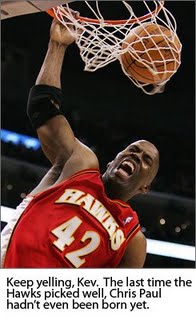 they used the #5 pick on Jon Koncak, missing All-NBAers Chris Mullin (#7) and Detlef Schrempf (#8), not to mention Hall of Famer Karl Malone (#13). The Hawks mistakenly gave Koncak a giant contract, handcuffing them from being able to be players in free agency for years (Koncak - later nicknamed "Jon Contract" - had a higher salary than Magic or Bird).
And finally, in '84 - widely considered the best class ever drafted - our search draws to a close, as the Hawks selected All-NBA player Kevin Willis with the 11th pick.
So, to sum up: in the 24 years since Willis, the Hawks have not only managed to not draft any worthwhile players, but shown a penchant to colossally misread talent without ever even accidentally getting it right. Now that says something.
What exactly it says is a story for another day. I accidentally hit "Publish" on this a while back, so I've got to stop here and have another crack at it tomorrow, when we'll cover what exactly it looks like when a team drafts intelligently. Such a reality does, apparently, exist.
Golden Globe Predictions
I got a new computer yesterday, so it seems that I'll finally be able to find a way to put a few posts together. I've missed blogging, but it's always so difficult to find time to post at work, and my computer had passed decrepit and moved into what I can only really call the computer form of incontinence (when you most want it to stay with you, it just goes).
Fortunately, I'm now endowed with bright, shiny new technology, capable of doing important computer-y things. So far I've used it to look at YouTube and send email, and while you can argue I'm not really getting the most out of it, those were both functions beyond the capability of my old computer.
With the Golden Globes coming up this Sunday, I thought I'd make sure to finally put together a post and give you my predictions. The end of the year is the best time to do posts about films, and amidst all the retrospectives and awards-groveling, it's the time of year when we can finally look back on the year and say, "boy, not much really happened, huh?"
For example, looking at the films nominated for Best Picture at the Globes this year, I can make a legitimate case that any of those films could win. How often is that the case? Usually by now there's a clear frontrunner - No Country For Old Men last year, The Departed and Babel the year before, Brokeback Mountain the year before that. Of the five films nominated this year, none of them has even a small jump on the others. And here's the real trick: I don't think either of the two best films of the year were nominated. Take a look:
MOVIES
Best Picture (Drama): The nominees are Slumdog Millionaire, The Reader, Frost/Nixon, Revolutionary Road, and The Curious Case of Benjamin Button. Now, I think moviegoers would agree that The Dark Knight got absolutely robbed in this category, but I also think that the best film this year, bar none, was Milk. These five films are just the best-of-the-rest, though, and it's all guesswork, but I'm gonna go with Benjamin Button, with Millionaire as the wild card. Why? Just a wild hunch. That's all we get this year.
Best Actress (Drama): No big frontrunners this year, either, but logic dictates that things will work out like this (at least, my logic does): Kristen Scott Thomas did the best work this work, but it's all in French, and that weeds out voters fast (especially Globe voters, who, let's just be honest, are a pack of 40-watts). Angelina Jolie was solid but not remarkable, Meryl Streep's here by name rather than performance, and Kate Winslet's going to win Best Supporting Actress for The Reader, so she's out. So that leaves Anne Hathaway, who gets votes because she's finally put together a great performance after a career of middling work combined with flickers of occasional promise. I think she'll definitely take it here.
Best Actor (Drama): Five great nominees this year, there's really not a middling performance in this bunch. While all of these guys here are name actors, none of them are here by name recognition; particularly Mickey Rourke, who's back from the dead to win huge acclaim in this role. I'll rank them like this:
- Sean Penn, Milk
- Mickey Rourke, The Wrestler
- Frank Langella, Frost/Nixon
- Brad Pitt, Benjamin Button
- Leonardo DiCaprio, Revolutionary Road
Best Actress (Musical Or Comedy): Meryl Streep is again nominated by name alone, though proper credit should be given to her about being such a sport throughout Mamma Mia! and not, at any point, looking at the camera and saying "this is complete bullshit, isn't it?" I couldn't have managed. She won't win, and if all is right with the world, Sally Hawkins will for Happy-Go-Lucky. Don't count out Emma Thompson, though, since the Association can't be trusted on this front.
Best Actor (Musical Or Comedy): Colin Farrell is, bizarrely, nominated for an award here, along with his co-lead, Brendan Gleeson. Let's discount them both and instead select from the other three. I think Dustin Hoffman takes it here, except that James Franco is nominated here for Pineapple Express and not nominated for a truly stunning turn in Milk, which was gypped across the board in these nominations. Don't discount a sympathy vote.
Supporting Actress: There's two nominees from Doubt, so they'll cancel each other out, but I think the real battle here is between Marissa Tomei and Kate Winslet, who both show their acting chops by getting completely naked. I think that even though it's famously unwise to bet on the five-times Academy snubbed Winslet, I think she takes it here.
Supporting Actor: Heath Ledger. It's not up for discussion. We may one day just call this award "The Ledger."
Best Animated Film: Lessee here, did Pixar come out with a film this year? They did. Have they ever been defeated? They have not. Was the film in question probably the pinnacle of all computer-generated movies? Almost certainly. Is there any point in continuing this paragraph as a series of questions. There is not. Wall-E wins by a landslide.
Foreign Language Film: My gut tells me it's a run-off between I've Loved You So Long and Waltz With Bashir, and I haven't seen either (I actually have't seen any of the nominees). I'm gonna go with Bashir, and I can't say why. I bet that I'm right, though.
Best Director: What David Fincher does not know about directing, I do not wish to learn. Whether or not you thought Benjamin Button was genius or an overlong, wandering tale, there's no question that Fincher combined CGI with good - damn good - performances and gave a fairy tale a surprisingly gritty, realistic twist.
Best Screenplay: I think this has to be the one area that Slumdog Millionaire finally takes home a win. Inventive screenwriting is what wins this category, and Millionaire has that in spades. Once again though, don't discount Benjamin Button.
Best Score: I think that Alexandre Desplat's Benjamin Button score is too good here, but the random Defiance nomination for James Newton Howard's makes me wonder.
Best Original Song: Bruce Springsteen, "The Wrestler." Never, ever - ever - bet against the aging rocker.
TELEVISION
Best Show (Drama): "Mad Men" continues it's sweep. No contest.
Best Actress (Drama): It should be January Jones, especially with her "Mad Men" resume, but the experienced name always carries this. It'll be Kyra Sedgewick again.
Best Actor (Drama): I gotta figure John Hamm gets this - he won last year, and there's no reason from the past season to think that he's any less deserving.
Best Show (Comedy): "30 Rock" will always be a critic's darling, and as long as it lasts, it will always win this award.
Best Actress (Comedy): Tina Fey should win again, though Christina Applegate came back from breast cancer this year, and that deserves something.
Best Actor (Comedy): I'd be happy with either Alec Baldwin or Steve Carrell, and I'm worried it might be Tony Shalhoub again (sigh), though I'm figuring instead it'll be a repeat of David Duchovny's win for his very nuanced "Californication" performance.
Best Mini-Series or Made For TV Movie: Hey, "John Adams" is nominated! I wonder who'll win?
Best Actress (Mini-Series): Hey, Laura Linney is nominated for "John Adams!" I wonder who'll win?
Best Actor (Mini-Series): Hey, Paul Giamatti is nominated for "John Adams!" I wonder who'll win?
Supporting Actress: I dunno on this one. Laura Dern was very, very good in Recount, so I'll go with that.
Supporting Actor: Jeremy Piven always wins this, and so he'll win again. I really wish Neil Patrick Harris would win one of these at some point, though.
I guess that about covers it. I'm hoping that my accuracy on this is superior to my Oscar accuracy, and so, with... 25 categories, I'm hoping to get 14. I can do this! We can build on this this!