Day Two: White Marble and Legends

Day Two: White Marble and Legends

There’s a grinding of gears from the front, and the bus pauses, then jerks forward sharply, sending all of us lurching out of our seats again. One of my hands clutches the camera; the other holds a death grip on the seat back. I click frame after frame out the side window, hoping for maybe a miracle or two out of several dozen blurred nothings.

The bus swings to the right as we switch lanes again, this time venturing for a short period into the oncoming lane and threading between motorcycles and rickshaws that honkingly announce their displeasure at this sudden behemoth with “TOURISM” splashed on its windshield.

I surrender to the inevitable and stow my camera away as the bus finally wobbles back over into its rightful land, trying not to sigh as potential photographs slip below my window and whisk away down the road.

As we shudder to a stop at yet another checkpoint, the navigator scrambles out of his bucket seat and climbs into the cabin with us. We are perhaps halfway between Delhi and Agra, on our way to see India’s crowning jewel, the Taj Mahal. What we were assured would be a three-and-a-half, perhaps four-hour journey has proved to be much more than that, and our enthusiasm is waning.

Day One: The Harsh Soft Light of Morning

Day One: The Harsh Soft Light of Morning

Slashes of  sunlight are drifting slowly across the wood paneling of the hotel lobby. I have nothing better to do, so my eyes chart their course across the wall, across plastic Greek columns and printed hotel paintings shipped in from wherever they print hotel paintings from.  At night, the nightclub next door beats its insistent thump through this room, but in the morning, it is quieter than most funeral homes. Only the whisper of cloth as the hotel workers pass back and forth breaks the silence.

The sharp change that comes from traveling halfway around the world has yet again briefly turned me into a deeply unwilling morning person.  I found myself fully awake well before the sun rose, and a few hours of tossing the sheets about and burying my head under the pillow later, I was finally forced to admit that sleep will not return.  So I’m slumped sleepily on one of the alarmingly vibrant love seats that dot the lobby – they’re decorated with a fabric I have entitled “Dizzy Zebra” – and am now trying to motivate myself to face the day.

"I've heard people reference Jack Kennedy before, Mr. Vice President..."

If you didn't watch the Vice Presidential debate, well, then - and it sounds weird to say this - you missed out. Let me put my vote in now that we permanently do away with the standard distant podiums, and have the candidates sit in close proximity for every vote. Ideally, they would both share a single porch swing next time. Or maybe a seesaw.

My thoughts during the debate went from, "boy, Biden is really tearing into him at this debate" to "boy, if Biden doesn't stop interrupting him, he's gonna undercut everything." Biden had Ryan beat at every turn, but he couldn't help himself, and his confidence started to play as arrogance, and became a bit bullying. I posted during the debate that I thought Biden had won the debate but would pay for it in the polls among independents. Since most of my Twitter followers are either dyed-in-the-wool conservatives, or liberals who believe they are the only free-thinkers in Texas, nobody agreed.

I am not much of a political wonk, but my prediction proved true, if not very dramatically so. While the overall country picked Biden as the winner, undecided voters leaned Ryan - and the very next day, Romney had another surge in the polls.

What stuck with me most, though, was the most famous soundbyte from Thursday's debate - Biden snidely calling out Ryan after he mentions Jack Kennedy. "Oh, now you're Jack Kennedy?"

This is about an hour into the debate, and tempers were clearly wearing thin. Neither of these guys sound that pleasant:

Here's a quick transcript if you didn't hit play:

RYAN: You can cut tax rates by 20 percent and still preserve these important preferences for middle-class taxpayers.

BIDEN: Not mathematically possible.

RYAN: It is mathematically possible. It’s been done before. It’s precisely what we’re proposing.

BIDEN: (laughing) It has never been done before.

RYAN: It’s been done a couple of times, actually.

BIDEN: It has never been done before.

RYAN: Jack Kennedy lowered tax rates, increased growth.

BIDEN: Oh, NOW YOU'RE JACK KENNEDY?

The more I think about this, the more it annoys me. Because, for the quote of the night, this is an inane response.

Biden kept saying that something didn't exist, and when Ryan gave an example, he taunts him for comparing himself to the example, then sits back with a look that clearly says, can you believe this guy? But the logic on Biden's side is not sound. There's a point to be made about Democrats and finances that Biden could've probably jumped into. After all, when Republicans reference Democrats in regard to taxation, that's a softball pitch. But instead, when Biden heard "Jack Kennedy", he saw a chance to make his own Lloyd Bentsen comment, regardless of context.

But the problem is, Ryan didn't compare himself to Kennedy, even implicitly. He just responded to Biden's taunts about the historical accuracy of his statement. And, while I have no idea if Jack Kennedy actually lowered taxes and increased growth or not, the debate from that point has to hinge on whether or not Jack Kennedy cut taxes in that fashion, and if so, does that mean you should vote for Romney and not Obama?

But Biden's retort is founded not on the conversation that they're having, but a mythical conversation that is clearly not taking place at the time of the comment.

Take it out of a political context. Let's say that the conversation was about something else where someone was refuting a point you made.

GUY 1: You can go to the library and pick up a book about a famous person from India.

GUY 2: There have never been any famous people from India.

GUY 1: There have been people from India who were famous. It’s definitely happened.

GUY 2: (laughing) There have never been any famous people from India!

GUY 1: There've been a couple, actually.

GUY 2: There have never been any.

GUY 1: Mahatma Gandhi was a famous India figure, known worldwide.

GUY 2: Oh, NOW YOU'RE MAHATMA GANDHI?


The whole thing unravels the further you push it:

GUY 1: ...and that's why we have a surplus of purple vegetables.

GUY 2: There have never been any purple vegetables.

GUY 1: There are purple vegetables.

GUY 2: (laughing) There have never been any purple vegetables!

GUY 1: There are a number of them, actually.

GUY 2: There have never been any.

GUY 1: Eggplants are available in every supermarket.

GUY 2: Oh, NOW YOU'RE AN EGGPLANT?


I don't suppose it really matters. By Monday, people will have forgotten the debate entirely, which is a shame, because there was a moment there I really thought the two were going to come to blows right there at the desk.

By the way, weight routine or no, I'd still give Biden two-to-one odds in that fight.

Review: The Perks of Being A Wallflower

The Perks of Being A Wallflower is an adaptation of the 1999 teen novel of the same name, the sort of earnest tome that inspires kids to proudly brand themselves “wallflowers” in a way that has nothing to do with Jakob Dylan, and that forced hundreds of high schoolers to learn what “epistolary” meant. Many high schools now assign the book as required reading, which is likely partly a statement on its quality and partly a way of subtly reminding students of the existence of the school’s counseling department.

I myself was fortunate enough to not be forced to read the book, which tends to negatively color one’s memories of a work (I’m looking at you, “Great Expectations”), but instead stumbled across it in college – a little too late to really fall in love with that kind of novel, certainly, but not too late to develop a real fondness. My memories of the book are vague, but warm. But I was a little uncertain when I heard that it was being adapted to film.

First of all, adapting books is tough. Adapting young adult novels is tougher. Adapting novels written in the first person in a series of letters to an unknown friend is tougher still. Adapting novels written in the first person in a series of letters to an unknown friend concerning love, pain, death, suicide, mental illness, sexual trauma, and the perils of high school into a bright, accessible teen movie seems nigh-impossible.

But then word came out that the book’s author, Stephen Chbosky (the pronunciation of whose name I’m quite uncertain of), would be adapting the novel into a screenplay himself.

Good news. My heart is warm.

Then word came out that Chbosky would be directing the film himself.

Not good news. I feel a chill across my back.

I’ve seen movies by first-time directors. Some of them – a few of them – are great. But that’s usually because they’re by people who’ve spent a lifetime preparing for that moment. They’ve been making short films in their backyard, done their dues as a commercial director, or spent decades on movie sets as an actor or technician. Chbosky doesn’t have any of that experience. He’s the guy who wrote the film adaptation of “Rent.”


So… why is this movie so good?


I’m serious, guys. It’s good. Real good. Amazingly good.


It’s not just that the performances are strong – though they are, and we’re absolutely going to get to that in a moment. It’s that the film is so well paced, so well knit together. There’s none of the haphazard, I’ll-know-better-next-time clunkiness that’s the trademark of new directors. It’s visually strong in a way dozens of major Hollywood directors never achieve. It’s tense. It’s magnetic. It’s… moving. How the hell is a director this inexperienced so sure-handed?

I don’t have any idea. I’d love to know. Certainly some of the credit has to go to the cast, though by the same token, you have to give Chbosky credit for getting such good performances out of his actors.

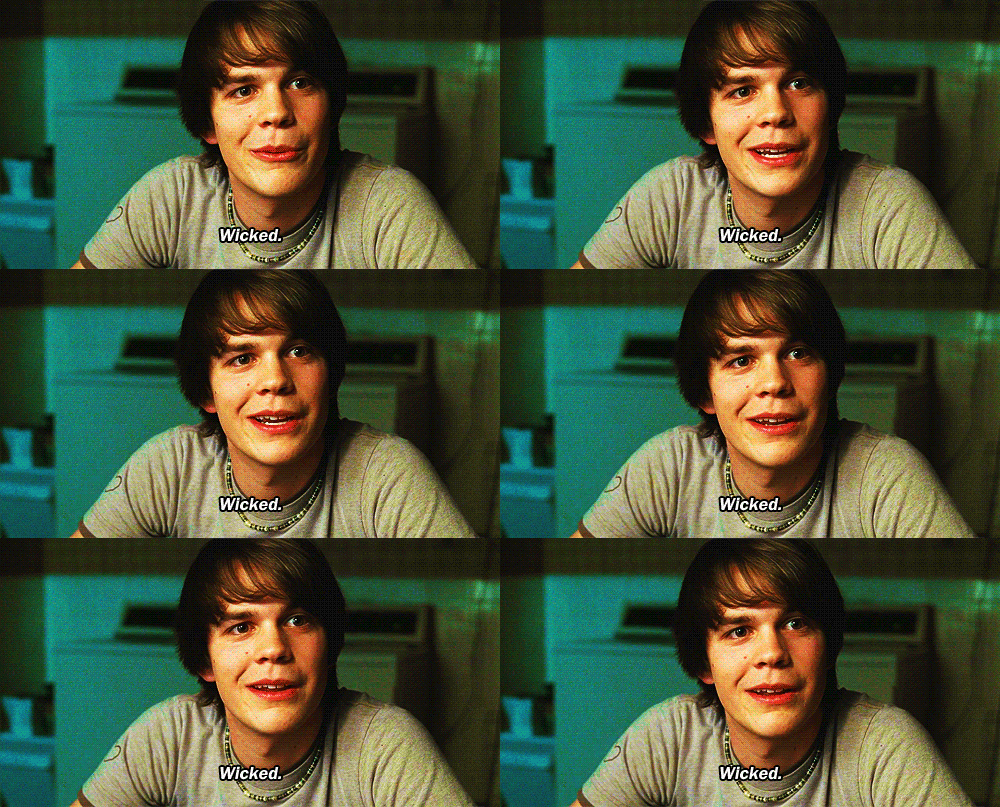
I know everyone always says it, but most of a movie like this really is casting, and Logan Lerman, the lead, and Ezra Miller (whom I’m just realizing now is perhaps the saddest possible version of the “gay best friend” ever) are both exceptional here. Lerman is frail and honest and small all at once, and he plays broken with real, accessible feeling, keeping the audience from that sense of distance that so spotted Joaquin Phoenix’s performance in The Master (I’ll review The Master when I’m good and ready. Which may be never).

The specter of his almost certain breakdown haunts the movie – Lerman is wound so tight that you know his newfound happiness can’t possibly last, and yet you root for it to anyway. His quiet is nicely counteracted by Miller’s ebullience, who sells the hidden melancholy with tiny breaks and almost imperceptible voice cracks. He’s ever bit the rising star We Need To Talk About Kevin hinted he would be, and the two are an unconventional, yet terrific pairing. If anyone wants to sell a studio a movie featuring Lerman and Miller as a pair of emotionally fragile rookie cops with something to hide, I can promise you that you’ve already got my nine dollars for an opening night ticket.

I would say that what you think about Emma Watson depends on what you already think of her, but I don’t think that’s true. Watson is forever Hermoine, and while she’s very good in this movie, she’s probably not the caliber of actress to ever really break away from that role. But there’s a reason why it’s so easy to buy her as the dream girl – she has a quality to her, a magnetism that jumps off the screen. It’s the reason why she’s one of the most searched Google terms of the past few years, and it’s easy to see why Lerman’s character is so instantly smitten.

The cast is rounded out by a collection of name actors seemingly far too famous to be in a movie this tiny: Dylan McDermott, Kate Walsh, Nina Dobrev, Melanie Lynskey, Mae Whitman, Joan Cusack - and most notably, Paul Rudd, who eschews comedy and drops his trademark cheek, and yet somehow seems more comfortable and compelling than I’ve ever seen him before.

Young Neil is also in this movie. He's not too big to be in it. But I just wanted to mention it.

Often times, already knowing the source material can dull a movie’s edge, but the imbalance at the center of Wallflower’s plot – the mental instability Lerman’s character struggles with – only makes the movie more tense for those in the know. There is a bomb at the heart of this movie, and fans of the book are no more privy to its timer than newcomers, only to the stakes of its explosion.

Movies about books like this never get made, and if they do, they always get their guts ripped out and replaced with dick jokes and radio-friendly pop songs. Go see a movie that centers its characters around their love of Smiths’ b-sides and then tries to sell that film to teenagers. The world’s a better place for it.